Industries

Regulated and mission-critical estates that cannot compromise

Public sector, banking, telecommunications, infosec, and transportation teams running sovereign Kubernetes and AI on infrastructure they control.

Industry · Public Sector

Public Sector

Sovereign AI and citizen services on infrastructure you control

Agencies must modernize with AI and Kubernetes while keeping data residency, auditability, and clear separation between departments. FusioNative gives ministers and operators the same truth—on-prem LLMs, fleet health, and tenant boundaries in one control plane.

Run AI and Kubernetes on sovereign infrastructure with audit-ready governance—not shadow IT in every department.

Who needs this

  • National cloud programs and digital-government platform teams
  • Agency CIO offices balancing innovation with data residency
  • Security architects preparing ISO, PDPL, and internal audit reviews

Industry pressures (why change)

  • Citizen-data workloads cannot land in unmanaged public clouds or opaque SaaS AI tools
  • Each agency wants autonomy, but central IT still needs fleet-wide visibility
  • Auditors ask for evidence across clusters, tenants, and model deployments—not screenshots in slide decks

Why FusioNative fits

  • On-prem LLM deployment wizards keep GPU, storage, and networking inside policy
  • Unified audit trails and tenant-scoped events support regulatory frameworks
  • Multi-tenant portal gives agencies quotas and billing without shared admin passwords

How teams adopt it

  1. Connect agency clusters and bare-metal sites to the central control plane
  2. Segment workloads per tenant with quotas, RBAC, and audit policies
  3. Deploy approved LLM stacks on-prem with validated GPU and storage steps
  4. Export audit evidence and capacity reports for oversight bodies
In Cloud Admin

What Public Sector teams see in the product

Product screens with notes on when each view matters for your sector.
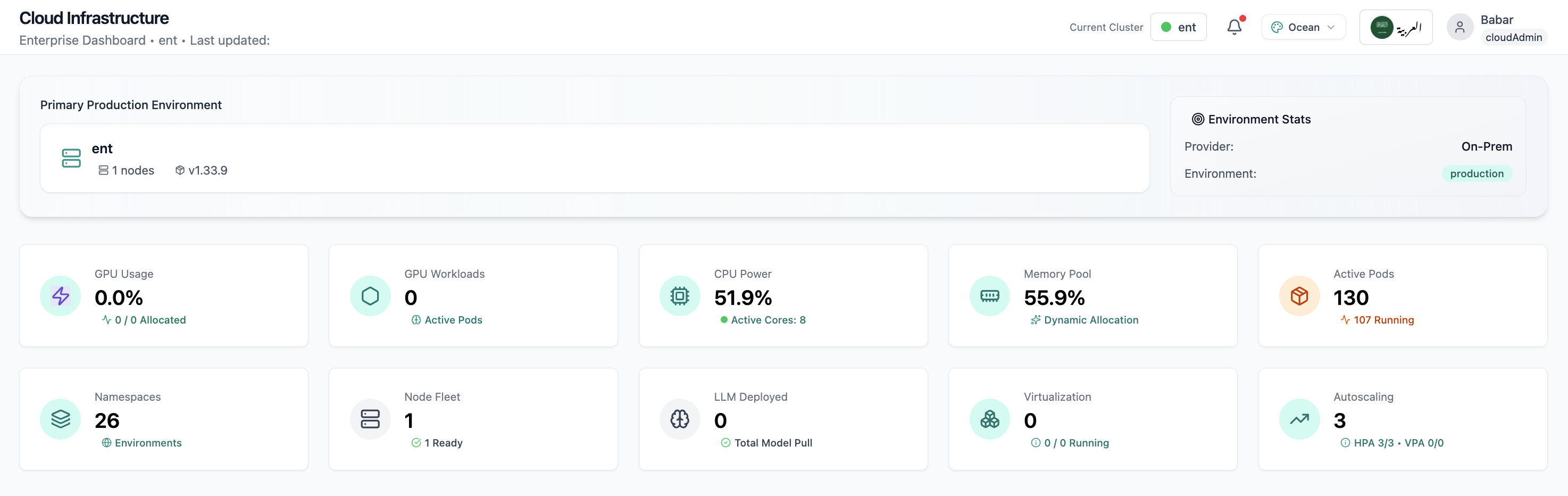
Leadership sees production posture, GPU utilization, and workload counts in one dashboard—ideal for cross-agency status reviews.
01of 03Cloud Admin

Enterprise fleet overview

Leadership sees production posture, GPU utilization, and workload counts in one dashboard—ideal for cross-agency status reviews.

  • Single pane for clusters, AI, and virtualization
  • Production context always visible
  • Drill down without losing environment scope

Click the screenshot to open full size, zoom, and pan.
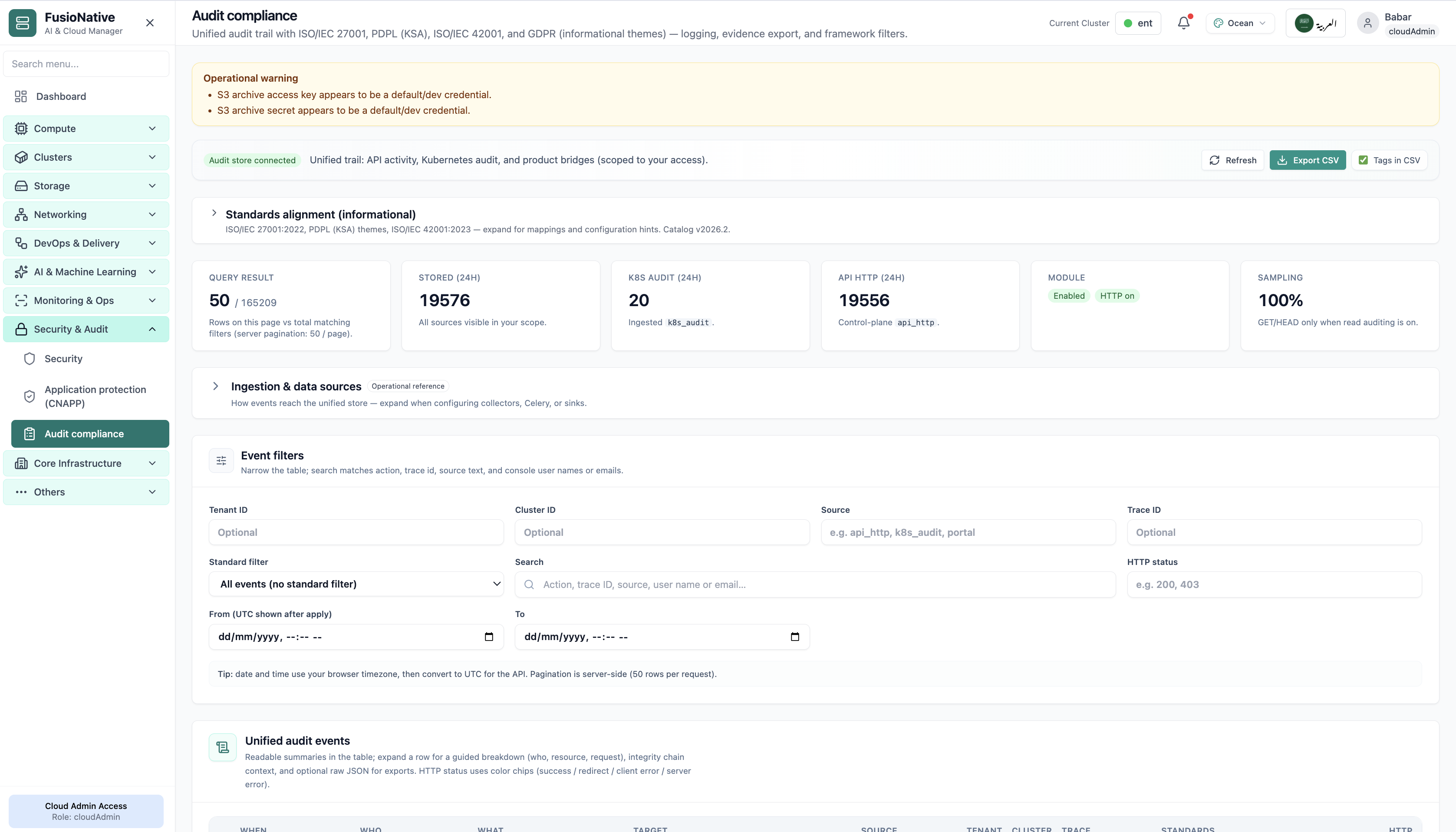
Filter unified audit events by framework and export CSV evidence for ISO, PDPL, and internal controls.
02of 03Cloud Admin

Audit & compliance

Filter unified audit events by framework and export CSV evidence for ISO, PDPL, and internal controls.

  • Framework-aware audit views
  • Tenant-scoped trails
  • Export for assessors

Click the screenshot to open full size, zoom, and pan.
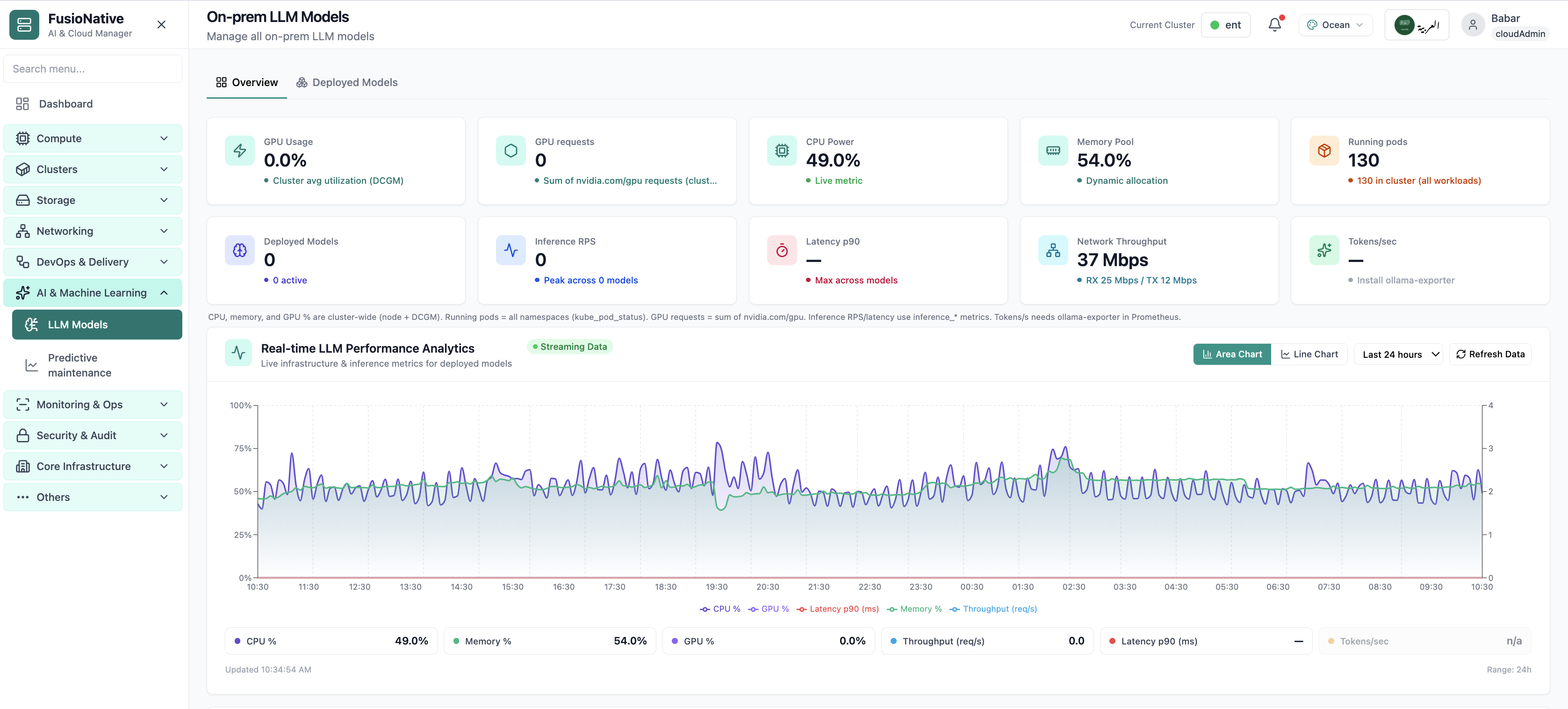
Deploy approved models inside your perimeter with a guided wizard—GPU, storage, and service exposure validated at each step.
03of 03Cloud Admin

On-prem LLM models

Deploy approved models inside your perimeter with a guided wizard—GPU, storage, and service exposure validated at each step.

  • Sovereign inference stays on-prem
  • Wizard prevents misconfigured GPU pools
  • Operations sees inference KPIs beside K8s metrics

Click the screenshot to open full size, zoom, and pan.

Industry · Banking & Finance

Banking & Finance

Compliance-first operations for trading, core banking, and analytics platforms

Banks run hundreds of namespaces across prod, DR, and analytics clusters. Regulators care about segregation of duties, immutable audit logs, and provable capacity headroom. FusioNative ties those requirements to everyday screens operators already use.

Give risk and platform teams shared evidence—security posture, audit exports, and capacity truth on every cluster.

Who needs this

  • Platform engineering for core banking and payments microservices
  • Risk & compliance officers preparing examination evidence
  • FinOps leads tracking GPU and compute spend by business unit

Industry pressures (why change)

  • Examination cycles demand exportable audit trails—not tribal knowledge in tickets
  • Security policies (RBAC, network policy, secrets) drift between clusters
  • Analytics and AI teams consume GPU capacity without transparent chargeback

Why FusioNative fits

  • Security Center centralizes roles, policies, secrets, and pod security standards
  • Audit compliance supports framework filters and tenant-scoped events
  • Capacity planning connects utilization trends to headroom before trading peaks

How teams adopt it

  1. Register production, DR, and analytics clusters with consistent RBAC baselines
  2. Enforce security policies from Security Center and track drift via events
  3. Run capacity reviews with 24h trends before month-end or market spikes
  4. Export audit logs and tenant usage for internal risk and external examiners
In Cloud Admin

What Banking & Finance teams see in the product

Product screens with notes on when each view matters for your sector.
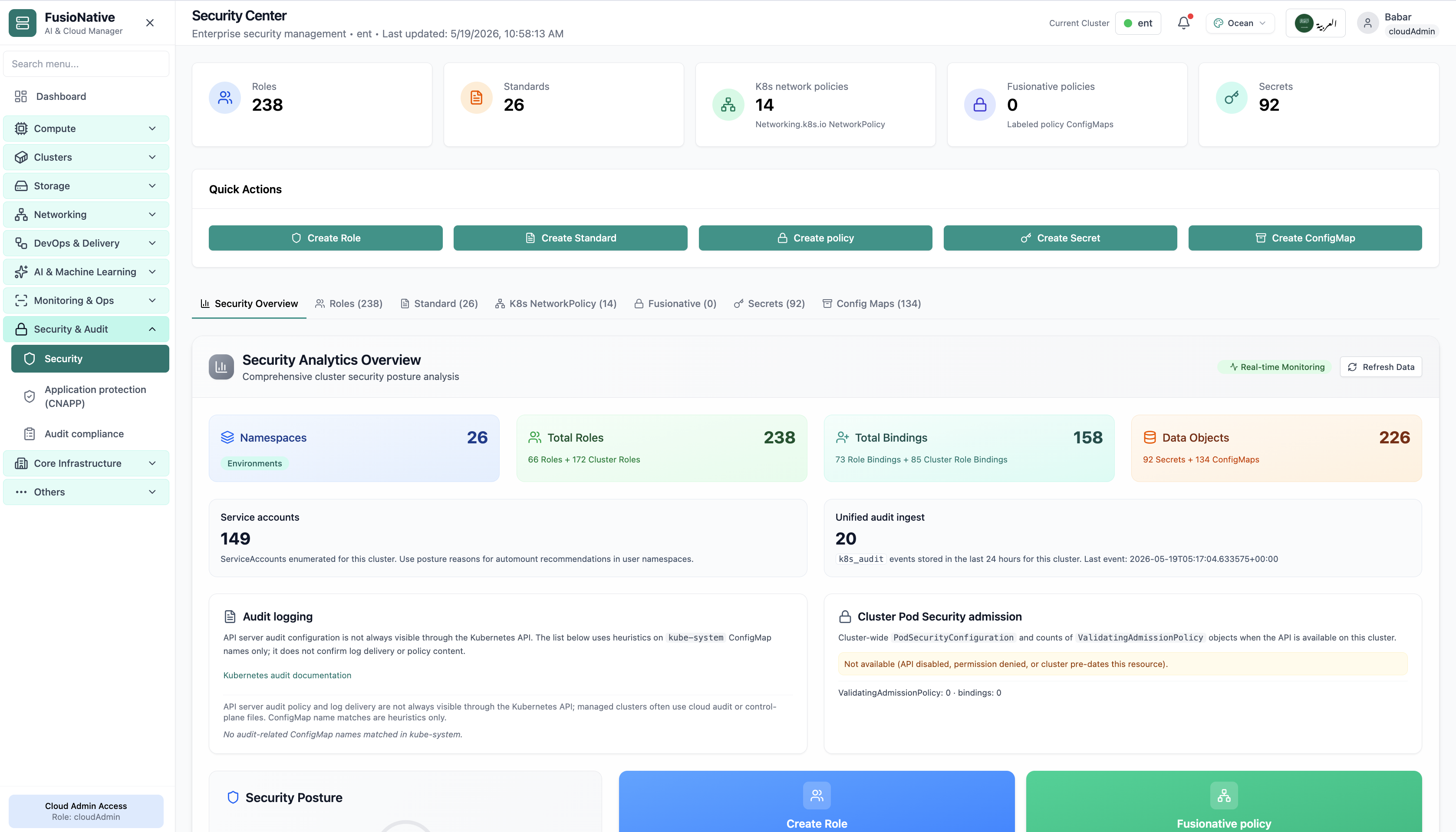
One workspace for roles, pod security, network policies, and secrets—how banks keep Kubernetes admission aligned with policy.
01of 03Cloud Admin

Security Center

One workspace for roles, pod security, network policies, and secrets—how banks keep Kubernetes admission aligned with policy.

  • RBAC and policy objects in one place
  • Guided creates reduce misconfiguration
  • Security KPIs beside operational metrics

Click the screenshot to open full size, zoom, and pan.
Unified audit trail with filters for frameworks your risk team already names in examinations.
02of 03Cloud Admin

Audit compliance

Unified audit trail with filters for frameworks your risk team already names in examinations.

  • CSV export for evidence packs
  • Correlate tenant and cluster scope
  • Fewer manual log hunts

Click the screenshot to open full size, zoom, and pan.

Forecast CPU, memory, and GPU headroom before batch jobs or model training squeeze trading adjacent systems.
03of 03Cloud Admin

Capacity planning

Forecast CPU, memory, and GPU headroom before batch jobs or model training squeeze trading adjacent systems.

  • Trends vs limits in one view
  • Supports FinOps chargeback conversations
  • Act before queues form

Click the screenshot to open full size, zoom, and pan.

Industry · Telecommunications

Telecommunications

Network-adjacent Kubernetes at core, edge, and OSS scale

Telcos operate Kubernetes at central offices, regional edges, and partner clouds—all with strict SLAs and noisy metrics volumes. FusioNative helps NOC and platform teams see health, events, and network-facing services without juggling disconnected tools.

Correlate cluster health, live metrics, and networking objects across distributed sites—the way NOC teams actually work.

Who needs this

  • Telco cloud platform teams running 5G core and OSS workloads
  • Edge operations groups managing regional cluster fleets
  • SRE teams responsible for cross-site incident bridge calls

Industry pressures (why change)

  • Edge and core clusters use different toolchains, so status meetings disagree on 'green'
  • High-cardinality metrics obscure which site or namespace is degrading
  • Network services, ingress, and workloads are managed in separate consoles

Why FusioNative fits

  • Live metrics and cluster events surface degradation before customer tickets spike
  • Multi-cluster settings align control planes for distributed sites
  • Networking workspace unifies services, ingress, and port-forward actions

How teams adopt it

  1. Onboard core, edge, and lab clusters into a single fleet inventory
  2. Monitor live performance analytics and cluster-scoped event streams
  3. Troubleshoot services and ingress from the networking workspace
  4. Promote changes through GitOps with the same navigation at every site
In Cloud Admin

What Telecommunications teams see in the product

Product screens with notes on when each view matters for your sector.
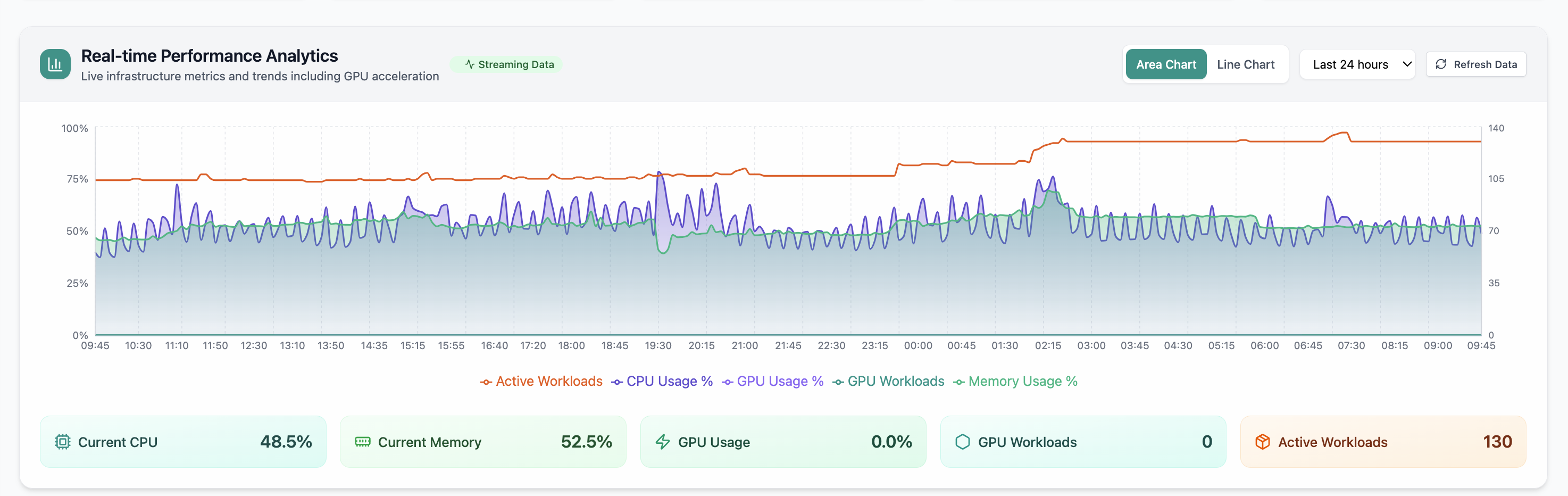
24-hour charts for CPU, memory, GPU, and workloads—how NOC teams spot regional spikes before they become outages.
01of 03Cloud Admin

Live performance analytics

24-hour charts for CPU, memory, GPU, and workloads—how NOC teams spot regional spikes before they become outages.

  • Real-time fleet telemetry
  • Compare sites on one timeline
  • Jump from chart to cluster detail

Click the screenshot to open full size, zoom, and pan.
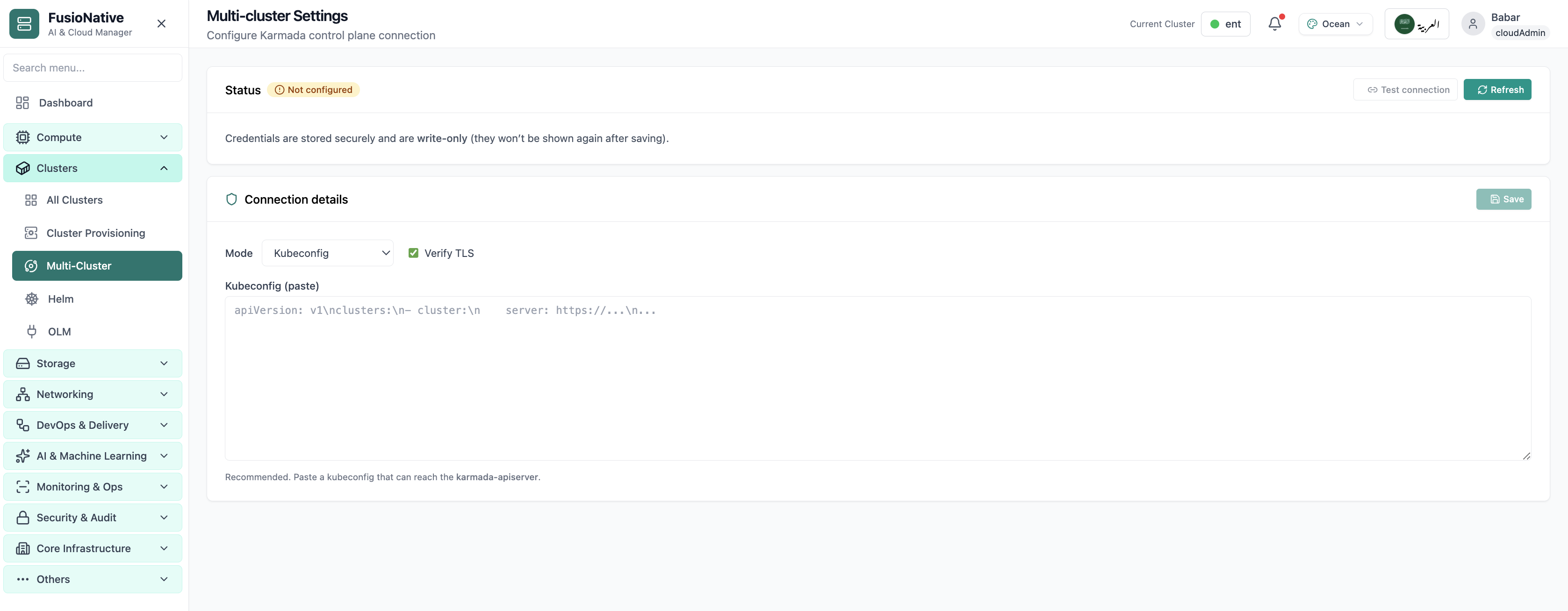
Karmada-style settings keep distributed clusters attached to one operational model.
02of 03Cloud Admin

Multi-cluster control

Karmada-style settings keep distributed clusters attached to one operational model.

  • Consistent policies across sites
  • Fewer one-off cluster snowflakes
  • Central team retains override

Click the screenshot to open full size, zoom, and pan.
Services, ingresses, and port forwards in one place—aligned with how telco platforms expose network functions.
03of 03Cloud Admin

Networking workspace

Services, ingresses, and port forwards in one place—aligned with how telco platforms expose network functions.

  • Cluster and namespace scope
  • Create and lifecycle services
  • Less context switching during bridges

Click the screenshot to open full size, zoom, and pan.
Industry · Infosec & Cybersecurity

Infosec & Cybersecurity

Security operations anchored in live Kubernetes evidence

Security teams are tired of CMDB snapshots that lie. FusioNative shows live RBAC, policies, secrets, and audit events from the clusters themselves—so detection, response, and compliance use the same objects platform engineers mutate.

Investigate and harden Kubernetes with Security Center, immutable audit trails, and cluster events—not stale spreadsheets.

Who needs this

  • Cloud security architects defining K8s guardrails
  • SOC analysts correlating platform events with incidents
  • GRC teams mapping controls to Kubernetes evidence

Industry pressures (why change)

  • Policy drift across clusters creates audit findings and incident blind spots
  • Secrets and network policies are scattered per cluster
  • After incidents, reconstructing who changed what requires manual log stitching

Why FusioNative fits

  • Security Center unifies roles, PSS, network policies, secrets, and config maps
  • Audit compliance exports framework-filtered evidence
  • Cluster events stream gives SOC timelines without bespoke parsers

How teams adopt it

  1. Baseline RBAC and pod security standards per environment tier
  2. Monitor cluster events for admission failures and policy violations
  3. Rotate secrets and validate network policies from one workspace
  4. Export audit trails tied to tenants and clusters for GRC tools
In Cloud Admin

What Infosec & Cybersecurity teams see in the product

Product screens with notes on when each view matters for your sector.

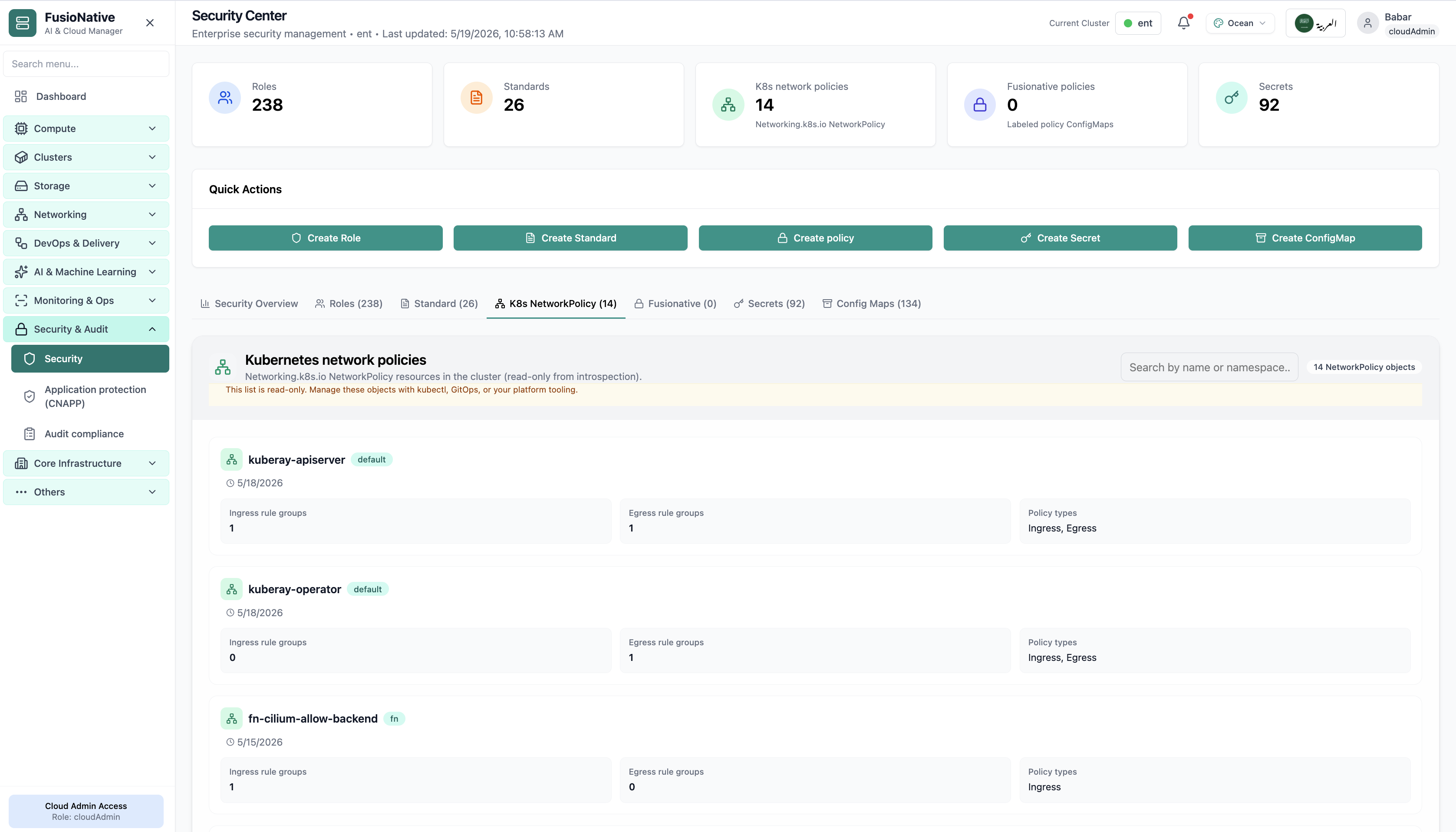
Security KPIs and analytics—start every hardening review with current posture, not last quarter's spreadsheet.
01of 03Cloud Admin

Security Center overview

Security KPIs and analytics—start every hardening review with current posture, not last quarter's spreadsheet.

  • Central security workspace
  • Guided policy creates
  • Tied to live cluster state

Click the screenshot to open full size, zoom, and pan.
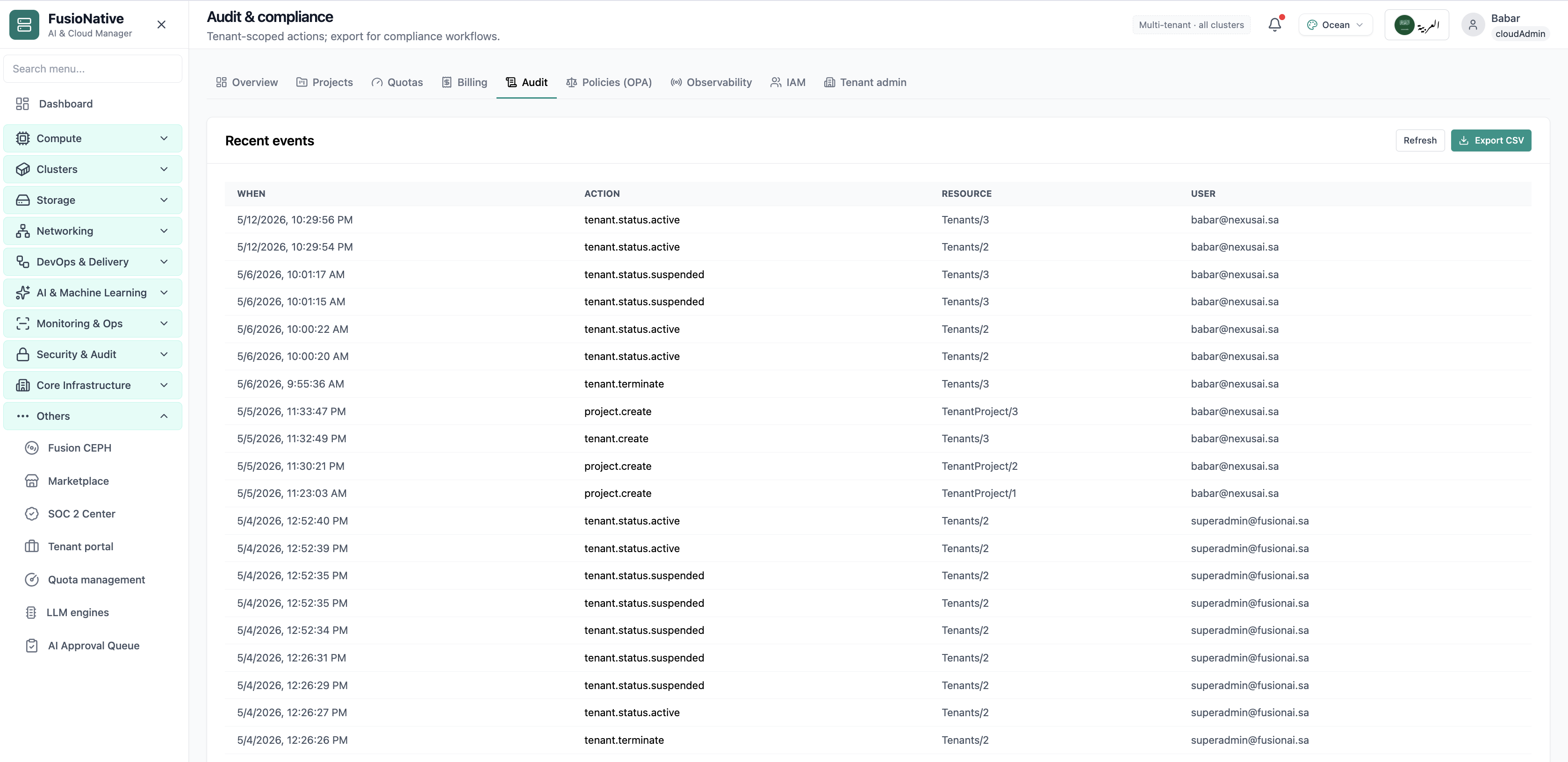
Review and manage network policies per cluster—how zero-trust teams prove segmentation between namespaces.
02of 03Cloud Admin

Network policies

Review and manage network policies per cluster—how zero-trust teams prove segmentation between namespaces.

  • Namespace-scoped policies
  • YAML and UI parity
  • Faster segmentation audits

Click the screenshot to open full size, zoom, and pan.

Tenant-scoped audit events with export for SIEM or GRC pipelines.
03of 03Cloud Admin

Tenant audit export

Tenant-scoped audit events with export for SIEM or GRC pipelines.

  • Immutable event stream
  • Tenant boundary respected
  • Export-ready for SOC

Click the screenshot to open full size, zoom, and pan.

Industry · Transportation & Logistics

Transportation & Logistics

Predictable operations for warehouses, fleets, and supply-chain platforms

Logistics platforms mix IoT ingest, routing engines, and warehouse systems on Kubernetes—often across regions with uneven connectivity. Downtime costs revenue per minute. FusioNative connects fleet health, predictive signals, and bare-metal provisioning so ops teams act before delays cascade.

See which sites and clusters are at risk, provision metal consistently, and run workloads with the same playbooks everywhere.

Who needs this

  • Supply-chain platform teams running regional Kubernetes
  • Operations centers monitoring hub and spoke deployments
  • Infrastructure leads standardizing bare metal to K8s at depots

Industry pressures (why change)

  • Regional clusters fail quietly until routing or warehouse apps backlog
  • Metal provisioning at depots is manual and slow
  • Maintenance windows are guessed instead of driven by risk scores

Why FusioNative fits

  • Predictive maintenance highlights fleet risk before hardware fails
  • Infrastructure management automates sites, machines, and MAAS workflows
  • Environment cards prioritize which cluster needs attention first

How teams adopt it

  1. Model depots and regions as infrastructure sites with MAAS-backed machines
  2. Attach clusters per region and monitor health scores centrally
  3. Review predictive risk and maintenance recommendations weekly
  4. Roll workload updates through GitOps with consistent observability
In Cloud Admin

What Transportation & Logistics teams see in the product

Product screens with notes on when each view matters for your sector.
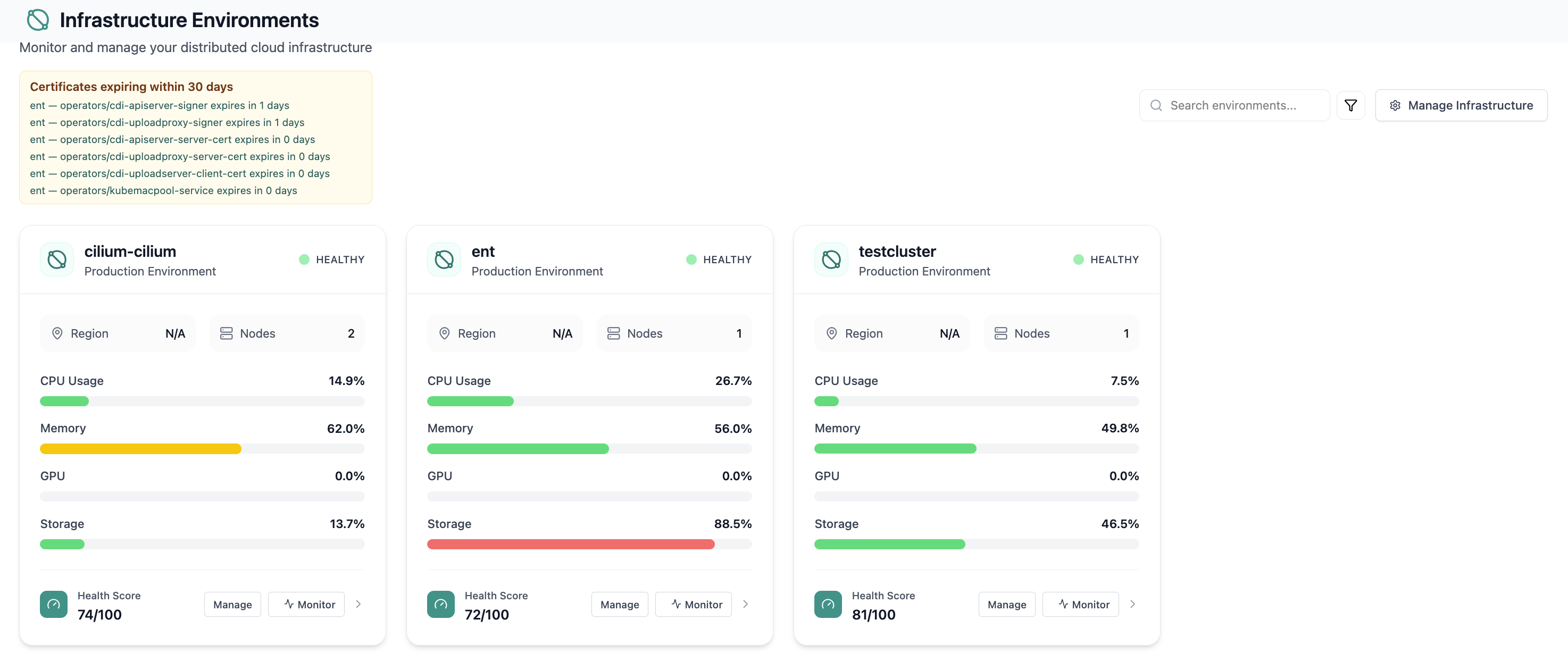
Health scores and utilization per environment—how logistics NOCs choose which region to fix first.
01of 03Cloud Admin

Infrastructure environments

Health scores and utilization per environment—how logistics NOCs choose which region to fix first.

  • Sort by risk and health
  • Compare utilization across hubs
  • Same language for managers and SREs

Click the screenshot to open full size, zoom, and pan.
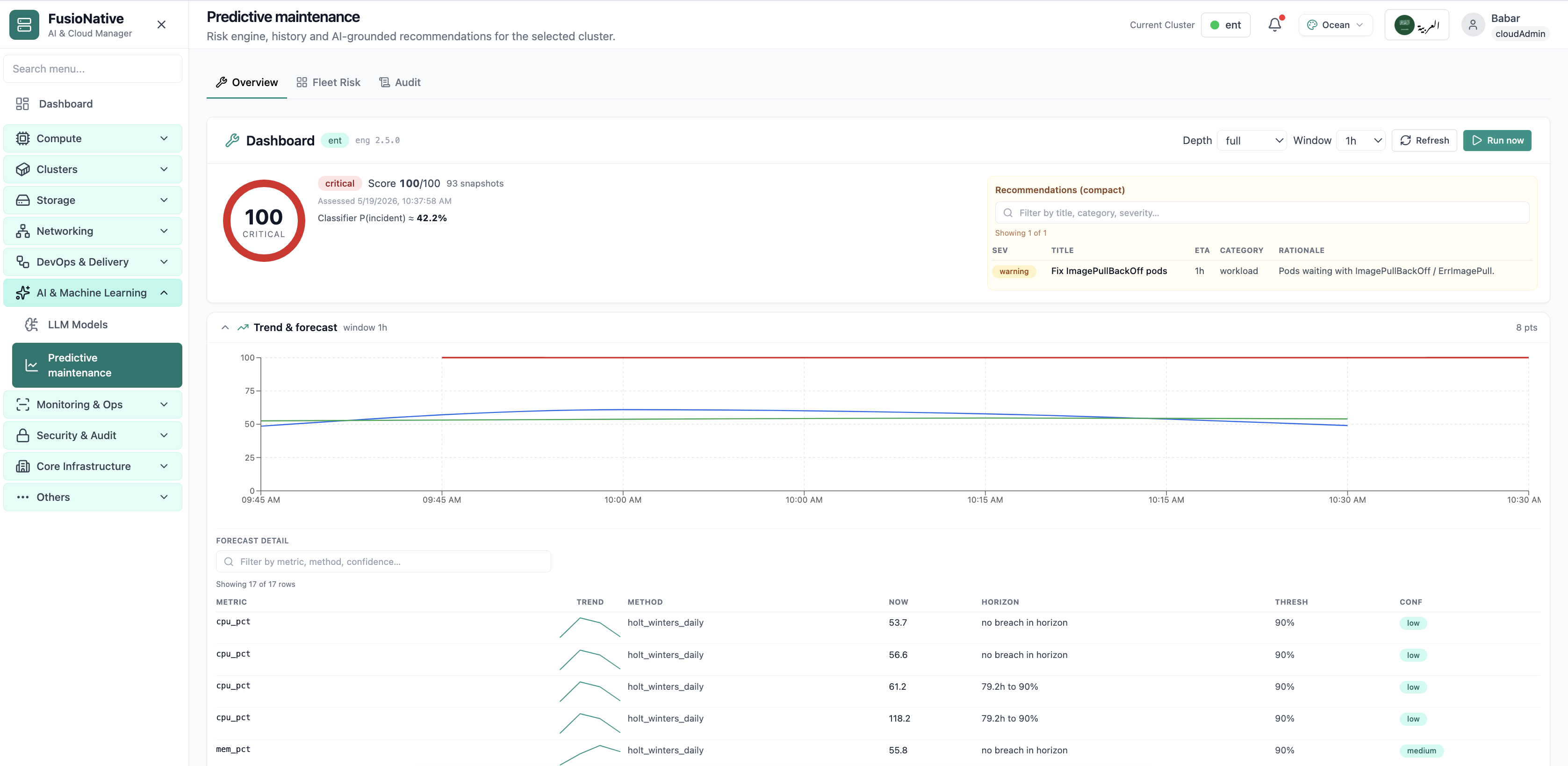
Risk scores and recommendations surface failing nodes or saturated pools before shipments stall.
02of 03Cloud Admin

Predictive maintenance

Risk scores and recommendations surface failing nodes or saturated pools before shipments stall.

  • Fleet-wide risk rollups
  • Actionable recommendations
  • Audit feed for changes

Click the screenshot to open full size, zoom, and pan.
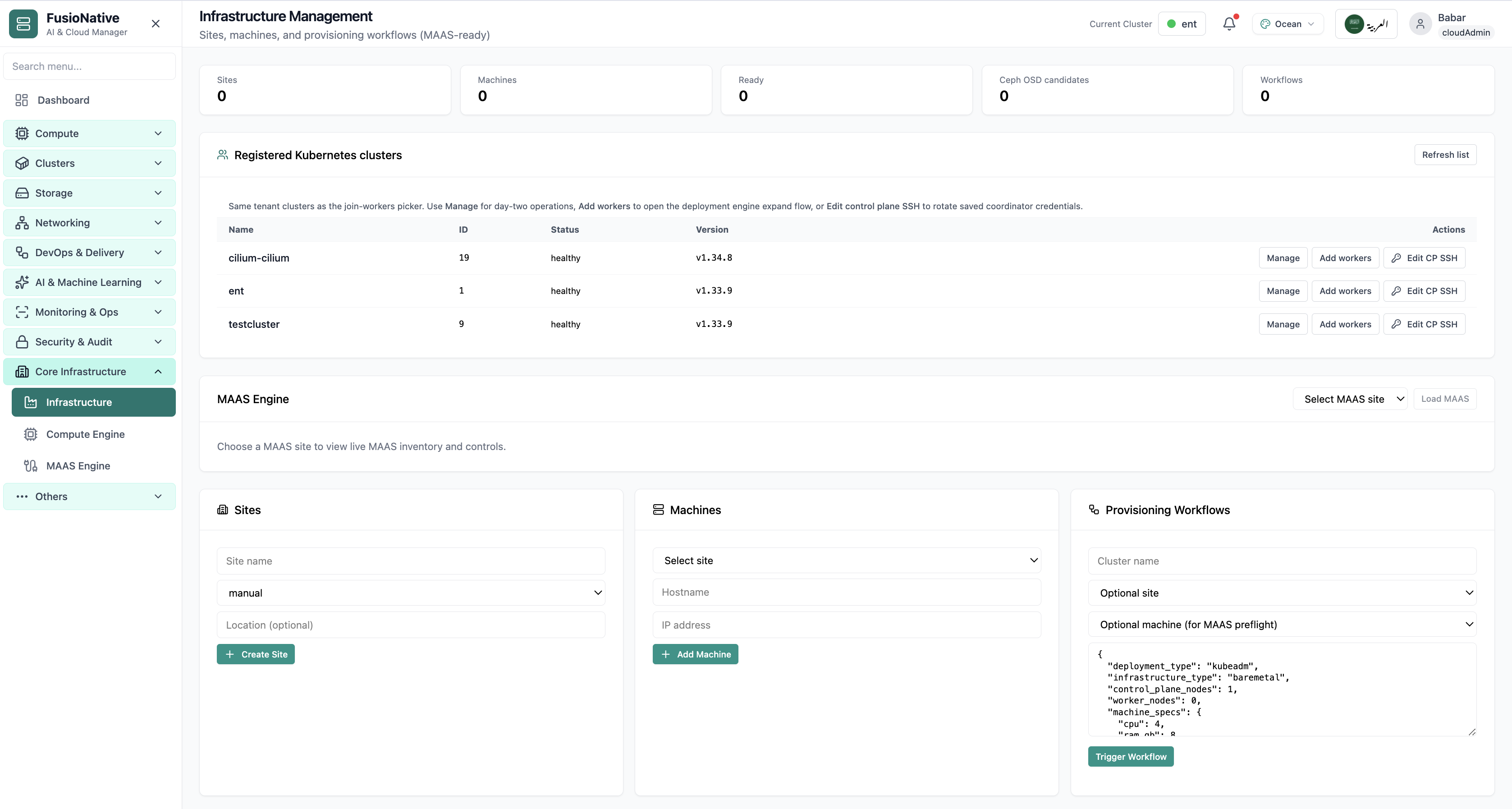
Sites, machines, and provisioning workflows—standardize bare metal at depots without one-off scripts.
03of 03Cloud Admin

Infrastructure management

Sites, machines, and provisioning workflows—standardize bare metal at depots without one-off scripts.

  • MAAS-integrated provisioning
  • Workflow triggers from UI
  • Ceph and kubeadm payloads ready

Click the screenshot to open full size, zoom, and pan.